Our Work
Accessible, inclusive, multilingual, and relevant knowledge through these three strategies:

Knowledge Hub
Anchored in the legacy of the Egyptian goddess of wisdom, writing, and knowledge, we leverage digital content creation to share multilingual, community-driven human rights, development, humanitarian action and climate change content.
Counselling Centre
Guided by the Mesopotamian goddess of transformation, justice and power, we provide expertise and capacity-building through training, conferences, consulting, consultations, and AI knowledge-shaping.
Micro-grants Hub
Offering micro-grants to support grassroots organisations and amplify local solutions, creating a dynamic feedback loop that enriches the platform’s shared knowledge and resources.
The Problem and Context
According to UNESCO, over 754 million adults lack basic literacy skills, and 251 million children and youth remain out of school worldwide. Meanwhile, 64.9 million young people are unemployed, and 1 billion adults have no formal schooling at all. These numbers are not just statistics; they represent a global failure to make knowledge accessible, inclusive and relevant.
Access to knowledge is not a luxury. It is a foundation for autonomy, participation, and dignity. Yet, for millions, systemic inequalities such as inaccessible formats, unaffordable delivery models, and cultural exclusion make knowledge unreachable.
There is urgency! And this is the relevance of Intersectionalities.org
754 million
ADULTS LACK BASIC LITERACY SKILLS
251 million
CHILDREN AND YOUTH OUT OF SCHOOL
64.9 million
YOUNG PEOPLE UNEMPLOYED
1 billion
ADULTS WITHOUT FORMAL SCHOOLING
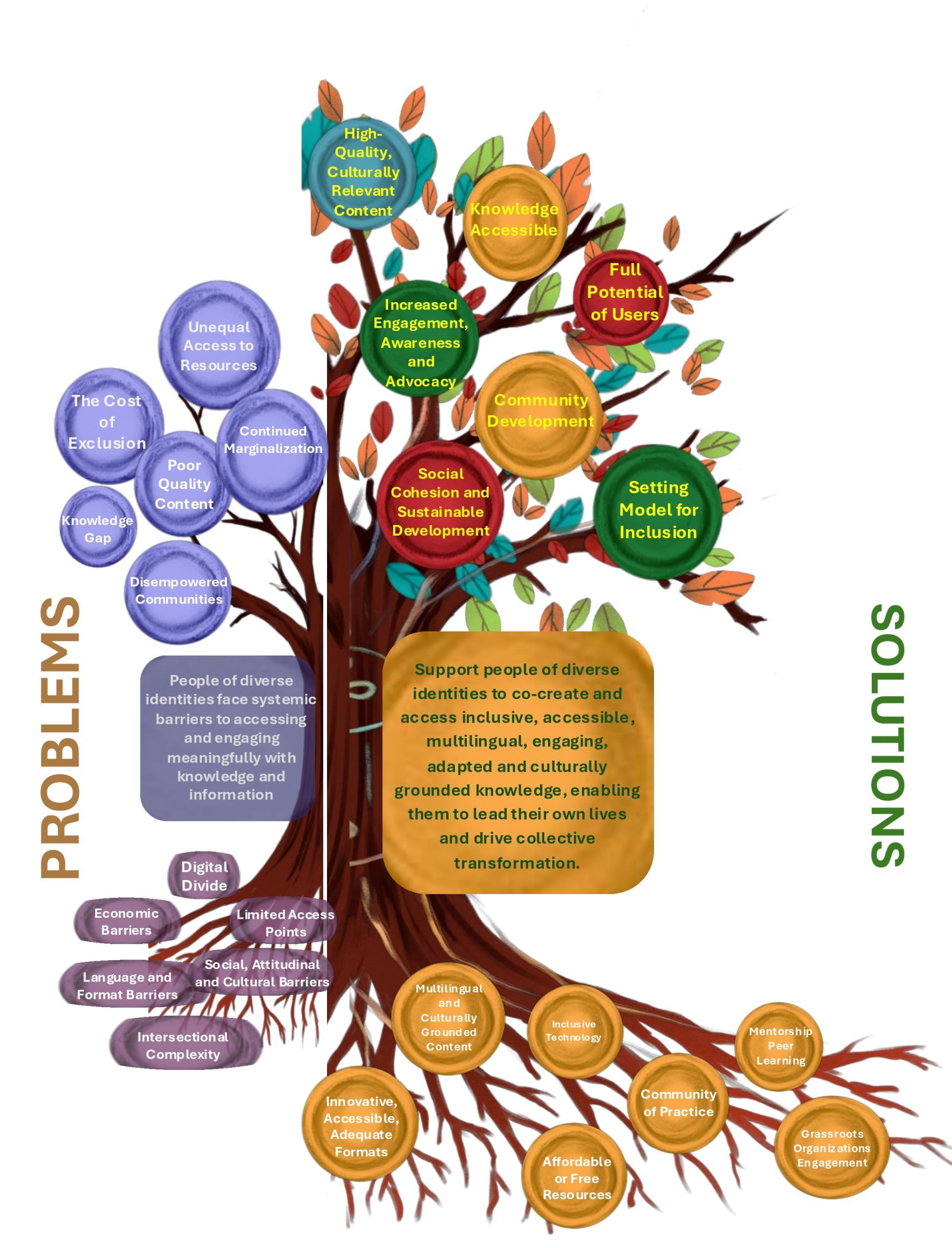
The Tree of Problems illustrates marginalised communities’ systemic barriers to accessing and engaging with knowledge. Deep-seated challenges such as economic barriers, inaccessible language and formats, limited access points, and the digital divide lie at their roots (causes). These issues intertwine with the complexity of the intersectional barriers and cultural prejudices, creating a trunk of exclusion where entire groups are systematically denied opportunities to access and meaningfully engage with knowledge and information.
The effects, symbolised by the branches, perpetuate inequalities, leaving communities uninformed, excluded, and unable to reach their potential. The cost of this exclusion is a loss for these communities and society, which misses out on their valuable contributions.
The Tree of Solutions emerges from this foundation, responding directly to each root problem with tailored strategies designed to dismantle barriers and foster inclusion. The tree’s roots focus on creating innovative, accessible, and multilingual content delivered in affordable or free formats. By incorporating inclusive technology and leveraging grassroots networks, the solutions address digital and social divides while offering mentorship and fostering collaboration with local organisations. At its trunk, this tree promises to deliver accessible, engaging, inclusive, adapted and quality
knowledge tailored to the needs of marginalised groups, laying the groundwork for transformative change.
The branches of the Tree of Solutions reveal a vision of empowerment and progress, where communities gain access to critical knowledge in accessible formats. This knowledge catalyses community development, fosters advocacy, and promotes inclusive societal progress. High-quality, culturally relevant content becomes the norm, inspiring a global model for accessibility and inclusion. In this way, the Tree of Solutions turns barriers into bridges of opportunity, ensuring that marginalised groups can fully participate, thrive, and contribute to a more just and equitable world.
Theory of Change
About
About
Work / Strategies
Donate
Get Involved