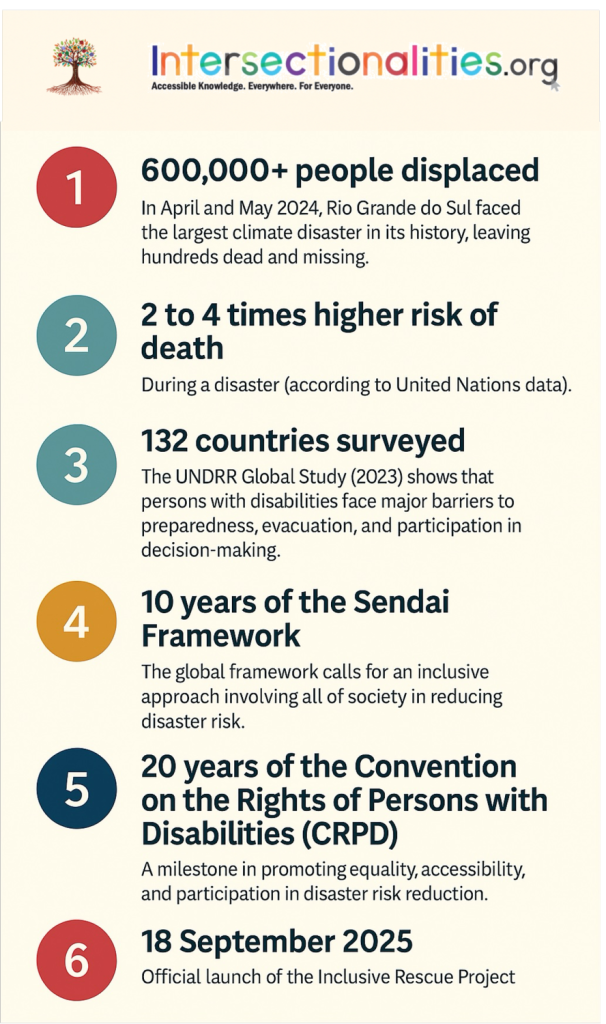
More than 600,000 people became homeless, hundreds of people were killed or are missing.
In addition to the human losses, the tragedy caused:
- environmental imbalance,
- loss of biodiversity,
- displacement of river fauna, and
- increased deforestation
Global Disaster Response Agenda:
The Sendai Framework, negotiated 10 years ago, was revolutionary in recognizing the role of civil society organizations as critical actors. It calls for an inclusive, whole-of-society approach, sharing responsibilities among governments, the private sector, academia, and communities.
Civil society organizations are bridges between institutions and communities, ensuring grassroots planning and local empowerment.
Increasingly frequent and severe disasters are occurring:
- Floods in Mozambique, Kenya, and Nepal.
- Heat waves and wildfires in Canada, Europe, and Asia.
- Two years’ worth of rain in one day in Dubai.
- And the sargassum line connecting Africa to the Americas.
These emergencies increase inequalities, and among those most affected are always the most neglected people.
Persons with disabilities
Persons with disabilities are 2 to 4 times more likely to die in a disaster. UNDRR’s global research (2023), covering 132 countries, shows that people with disabilities still face significant barriers at all stages: prevention, evacuation, reconstruction, and decision-making.
Worldwide, few persons with disabilities are aware of national risk plans or have access to accessible shelters and warning systems.
Launch of the Inclusive Rescue Project
On September 18, 2025, we launched the Inclusive Resgate Inclusivo, aiming to support public actors in developing accessible action plans to address climate change, starting in Southern Brazil and expanding nationwide.
Tired of waiting for concrete actions, Marta Almeida Gil of the Amankay Institute mobilized a network of experts and allies to rethink how we prevent, prepare for, and respond to disasters. The project brings together technical expertise, human rights, lived experience, and local knowledge.
Tuca Munhoz, Rita Mendonça, @MaraGabrilli, @AnnaPaulaFeminella, @ChristinaFreitas, @DrIzabelMaior, @ValdireneSilgadeAssis, #Intersectionalities.org, and others.
The paradigm needs to change:
From “saving people” to working with them as knowledgeable actors!
Concrete Actions – Check list:
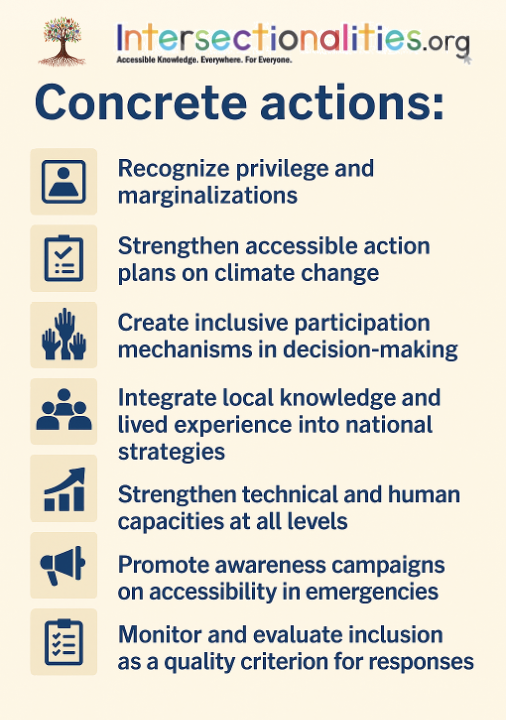
- Recognize privileges and marginalization → Recognize that poor people, persons with disabilities, people from peripheral areas, Black people, Indigenous peoples, and other historically marginalized groups face more disasters and social vulnerability than other members of society.
- Strengthen accessible climate change action plans → Support governments and municipalities in creating risk and emergency management plans with accessibility and universal design, including accessible formats for information, alerts, and response.
- Create mechanisms for inclusive participation in decision-making → Ensure that persons with disabilities and marginalized communities actively participate in the planning, implementation, and monitoring of disaster risk reduction policies.
- Integrate local knowledge and lived experience into national strategies → Value community, indigenous, and local knowledge as an essential part of disaster prevention and response, as a structural component, not as a complement.
- Strengthen technical and human capabilities at all levels → Empower public professionals, volunteers and civil society organizations in inclusive approaches to risk management and reconstruction (Sendai Framework and CRPD).
- Promote awareness campaigns on accessibility and reasonable accommodation in emergencies → Develop and disseminate accessible educational materials on emergencies and disasters, strengthening the culture of prevention of and inclusion in schools, communities, civil protection and the media.
- Monitor and evaluate inclusion as a response quality criterion → Incorporate accessibility, equity, inclusion and reasonable accommodation indicators into all disaster policy monitoring and evaluation mechanisms.
Note: This is an excerpt from a five-minute presentation. For more information and advice, please contact Tchaurea@intersectionalities.org.